
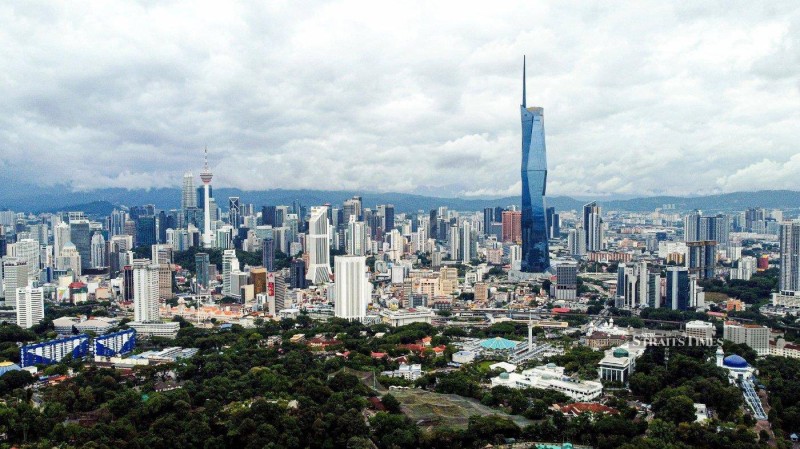

MALAYSIA today presents the outward appearance of stability. Growth remains respectable, institutions function, and the federation holds.
Yet beneath this surface lies a degree of brittleness that deserves sober attention.
The country's economic structure remains concentrated in a narrow set of pillars - electronics and electrical manufacturing, hydrocarbons, and a small group of large government-linked corporations.
These sectors have delivered scale and efficiency, but they also expose the economy to external shocks over which Malaysia exercises little control.
A single shift in global trade rules, export controls, or commodity prices can transmit rapidly through supply chains, fiscal revenues and employment.
Political arrangements, particularly federal - state relations over natural resources and regulatory authority, add a further layer of structural sensitivity.
These arrangements have endured, but they rest on constitutional ambiguities that can harden into fault lines under stress. In a brittle environment, strength without redundancy becomes a liability rather than an asset.
An Economy and Society Living with Anxiety
Alongside this brittleness runs a quieter but pervasive anxiety. Policymakers operate under the constant pressure of making decisions whose consequences are both immediate and politically costly.
Subsidy reform, climate commitments, industrial policy, and geopolitical positioning all require trade-offs that are difficult to sequence and even harder to explain to a public already strained by cost-of-living pressures.
Businesses, for their part, confront exchange-rate volatility, shifting regulatory expectations, labour constraints and an international environment in which market access can no longer be taken for granted.
Households experience these anxieties more directly - through stagnant wage growth, housing affordability challenges, and uncertainty about job quality in a rapidly changing economy.
The cumulative effect is a national mood that favours caution over initiative. When anxiety becomes structural, it dampens risk-taking, slows reform, and narrows the space for strategic ambition.
When Small Shocks Produce Large Consequences
Malaysia's operating environment has also become unmistakably non-linear.
Events that once might have been absorbed now generate outsized effects. A single tariff decision in a distant capital can ripple through Penang's factories, Klang Valley logistics networks and national growth projections.
Disruptions at key maritime chokepoints, or even congestion at neighbouring ports, can cascade into production delays and lost contracts.
In the political and social domain, a minor incident can escalate rapidly through digital platforms, compelling responses that are disproportionate to the original trigger.
Climate events display similar dynamics: one severe flood can impose billions in losses, disrupt data centres and transport corridors, and erode investor confidence well beyond the affected area.
In such conditions, linear planning models lose much of their predictive power.
Policy In An Incomprehensible Landscape
Compounding these challenges is a growing sense of incomprehensibility.
Technological systems - particularly in artificial intelligence, digital platforms, and automated finance - now evolve faster than regulatory and institutional frameworks can reasonably keep pace with.
Geopolitics no longer conforms to clear blocs or stable alignments. Malaysia finds itself engaging simultaneously in friend-shoring, China-plus-one strategies and Asean-centred diplomacy, often within the same industrial sector.
Economic signals, from capital flows to currency movements, increasingly reflect algorithmic trading and global sentiment rather than domestic fundamentals alone.
Social attitudes, especially among younger Malaysians, shift with a speed and intensity that traditional instruments of measurement struggle to capture.
Policymaking, in this context, is less about precise control than about continuous interpretation and adjustment.
A Strategic Imperative
The implication is not that Malaysia is entering a period of instability, but that it is operating in a BANI world - brittle, anxious, non-linear and incomprehensible.
Earlier frameworks such as VUCA were valuable in highlighting volatility and uncertainty in an era of globalisation and market integration, when shocks were disruptive but systems generally remained intelligible and recoverable.
Today's environment is more exacting. Systems that appear robust can fracture abruptly, psychological strain shapes economic behaviour as much as material conditions, and cause and effect no longer move in predictable proportion.
Events unfold at speeds and scales that overwhelm traditional planning assumptions, while technological and geopolitical interactions increasingly defy linear explanation.
The strategic task, therefore, is no longer to manage volatility alone, but to govern fragility. This requires greater emphasis on resilience rather than optimisation, on risk management rather than risk avoidance, and on strategic foresight rather than static planning.
One practical signal of this shift would be the systematic use of scenario planning and dedicated strategic foresight units within the core economic ministries - tasked not with prediction, but with stress-testing policies against geopolitical, technological and climate shocks.
It also calls for stronger analytical capacity within the state, clearer buffers between politics and regulation, and more professionalised mechanisms for managing federal-state relations.
In an age of BANI, durability lies not in pretending that shocks can be prevented, but in ensuring that when they arrive, the system bends without breaking.
*The writer is an analyst of global politics, business and economics. He is an adjunct lecturer at Universiti Teknologi Petronas and a senior consultant with Global Asia Consulting. He writes on global perspectives, strategy and statecraft, offering strategic insights for a complex world. The views expressed here are entirely his own.
Source: Governing in a brittle world: Malaysia in the age of BANI