

GLOBAL trade is entering one of its most volatile periods in decades.
Shifting alliances, tariff shocks and supply chain disruptions have reshaped the world economy, forcing nations to rethink how cooperation and competition coexist.
Amid this turbulence, Malaysia is steering ASEAN to remain open, adaptable and fair by promoting regional resilience through inclusivity and innovation.
The goal is not just to keep trade flowing, but to ensure that growth benefits smaller firms and workers who sustain the region’s economy.
Prime Minister (PM) Datuk Seri Anwar Ibrahim said the global economy is undergoing a deep transition as countries adjust to new power dynamics and fading certainties.
“Old certainties are fading and new alignments are emerging,” he said at the recent DHL GoTrade Summit 2025.
He said rigid trade frameworks are proving less effective in a fragmented world, calling instead for more flexible cooperation.
“Perhaps the path forward lies not only in binding arrangements that often falter under competing interests, but in voluntary and flexible facilitation protocols that produce tangible outcomes and genuine trust,” he added.
Anwar said shifting policies and protectionist measures have redrawn global supply chains, making regional cooperation essential.
“Such turbulence reminds us of the importance of resilience, agility and regional cooperation,” he said.
He noted that ASEAN’s openness has made it one of the most dynamic regions in the world. With 680 million people and a strong manufacturing base, it has become a crucial link in global trade and is projected to become the world’s fourth-largest economy within five years.
Malaysia, he added, aims to strengthen its position as a trusted investment hub while ensuring that local businesses can compete globally.
The government continues to expand financing and digital support for small and medium enterprises (SMEs) to enhance competitiveness.
“Digital transformation, artificial intelligence (AI) and automation are no longer luxuries; they are the very tools that will determine competitiveness in the years ahead,” he said.
Anwar said Malaysia’s chairmanship of ASEAN this year is guided by inclusivity and sustainability to ensure that economic progress uplifts communities alongside output.
He said economic progress must be measured not merely in figures, but in the dignity of work, the well-being of families and the fairness of opportunity.
Anwar said the Regional Comprehensive Economic Partnership (RCEP) remains central to ASEAN’s role in global trade.
“For ASEAN, it represents far more than an economic arrangement; it is a strategic affirmation that open regionalism remains our pathway to shared prosperity,” he said.
Malaysia will host the 5th RCEP Leaders’ Meeting to reinforce ASEAN’s central role and ensure the pact benefits SMEs, workers and communities.
Anwar said the success of RCEP will depend on the members’ ability to translate commitments into opportunities.
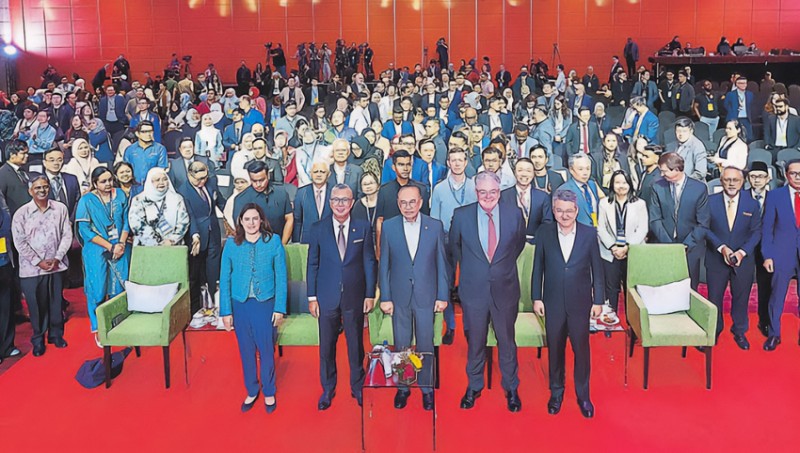
Despite geopolitical tensions, globalisation is evolving, not collapsing, says Pearson (centre)
ASEAN Must Convert Ambition into Action
Investment, Trade and Industry (MITI) Minister Tengku Datuk Seri Zafrul Tengku Abdul Aziz said 2025 has been one of the most volatile years for global commerce, driven by geopolitical rivalries, climate pressures and economic fragmentation.
“I am sure all of us agree that 2025 has been a pretty volatile year for global trade —underpinned by trade networks that have been re-tuned and re-tooled by tariffs, trade wars, as well as turf wars,” he said.
He said smaller firms are the most exposed to these shocks and must be supported through regional policies that strengthen competitiveness.
“This is precisely why we need to re-think and re-tune trade differently, particularly to help our MSMEs shape, sustain or shift their strategy, where necessary,” he added.
Tengku Zafrul said Malaysia’s ASEAN Chairmanship this year focuses on inclusive and sustainable trade. He added that Malaysia is committed to elevating ASEAN as a beacon of economic resilience, opportunity and regional cooperation.
With a combined GDP of almost US$4 trillion (RM19.2 trillion), ASEAN is now the world’s fifth-largest economy and third-largest trading bloc.
Despite global headwinds, foreign direct investment (FDI) in the region rose 8% last year, reflecting investor confidence in ASEAN’s openness and stability.
Domestically, Malaysia’s Madani Economy Framework and New Industrial Master Plan 2030 (NIMP 2030) are aimed at deepening SME participation and accelerating the shift towards green and digital industries.
“To build the country’s export resilience, we must transform our SMEs into hidden champions — globally competitive firms with niche expertise, homegrown technologies and innovations,” Tengku Zafrul
said, adding that this transformation requires a whole-of-nation effort with the cooperation of both public and private sectors.
He said initiatives like DHL’s GoTrade programme illustrate how collaboration can translate policy into results.
The programme supports MSMEs with export training, financing and logistics assistance, linking them to regional value chains.
“I was pleased to know that the DHL GoTrade has created an ecosystem with partners from both the public and private sectors, all helping MSMEs address operational challenges including access to financing, logistics, export know-how and technology,” he said.
He stressed that ASEAN’s strength lies in turning ambition into practical cooperation with Malaysia fully embracing the heavy responsibility of elevating and positioning ASEAN as a viable global convenor in an era of geopolitical discontent and geoeconomic disruption.
Tengku Zafrul says, to build Malaysia’s export resilience, we must transform our SMEs into hidden champions
Trade Resilience Lies in Openness, Not Retreat
DHL Express CEO John Pearson said despite geopolitical tensions, globalisation is evolving, not collapsing.
“The global trade landscape has changed but not for the worst — it is simply evolving as it has done since the ‘age of discovery’ in the late 15th century and it will continue to take its natural shape over time,” he said.
He said Asia Pacific and ASEAN are now driving the recovery, with six of the world’s 10 fastest-growing trade routes originating from Asian economies including Malaysia and Vietnam.
“Asia Pacific and ASEAN are playing an increasingly central role in driving global trade resilience,” he said.
Pearson said smaller businesses face the greatest risk from disruption and must be supported through cooperation.
He agreed that there is a need for an accelerated joint cooperation between the public and private sectors to advance the agenda of breaking down trade barriers for this sector.
Since 2021, DHL’s GoTrade programme has reached 14,000 small firms and 5,000 women-owned enterprises across 60 countries. In Malaysia, it has trained more than 2,000 participants with partners such as the Malaysia External Trade Development Corp (Matrade) and The Asia Foundation.
He said hosting the summit in Kuala Lumpur (KL) for the first time outside Germany marks a milestone for the programme. “This is the first time that we have taken the GoTrade programme out of Germany and in view of Malaysia’s ASEAN chairmanship this year, we decided to host the event here on a much larger scale,” he said.
Looking ahead, DHL plans to expand GoTrade to all ASEAN countries beginning in 2026. Pearson closed with a reminder that trade remains a unifying force. “The conversations and discussions we’ve had today show that we must work even harder to ensure the inclusivity and the accessibility of MSMEs, paving the way toward shared prosperity,” he said.
Source: https://themalaysianreserve.com/2025/10/28/malaysia-leads-asean-push-to-rebuild-trust-in-global-trade/