
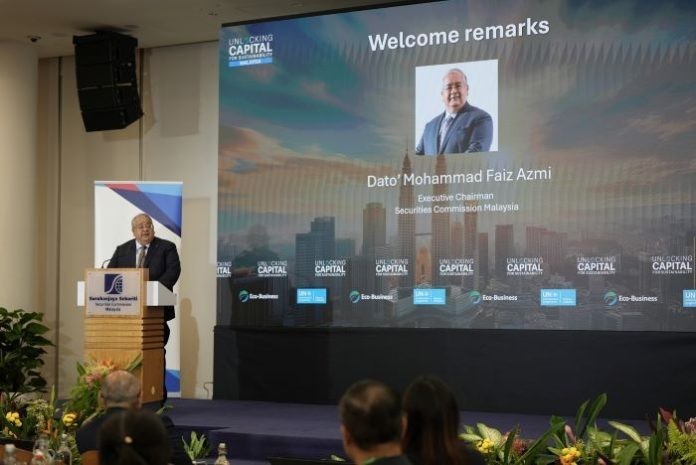

Securities Commission Malaysia (SC) Chairman Dato’ Mohammad Faiz Azmi has urged businesses and regulators across ASEAN to view sustainability not as an afterthought, but as a strategic imperative essential to long-term growth and resilience.
Speaking at the sixth SIDC–CASI Sustainable and Responsible Investment (SRI) Conference 2025, Dato’ Faiz emphasised the importance of embedding sustainability in every aspect of business operations, while highlighting Malaysia’s leadership role as Chair of the ASEAN Capital Markets Forum (ACMF).
“This year’s conference comes at a pivotal time as ASEAN pushes for a more sustainable and inclusive future,” said Dato’ Faiz. “We must collectively invest in building resilience to tackle climate change and economic uncertainty.”
Organised by the Securities Industry Development Corporation (SIDC) in collaboration with the Capacity-building Alliance of Sustainable Investment (CASI), the conference was themed ‘Shaping the Future of ASEAN Business in Sustainability’, reflecting regional efforts to align economic growth with environmental and social priorities.
Mobilising Capital for Green Growth
Dato’ Faiz noted that while ASEAN is poised to be a key global growth driver, significant green investments—estimated between USD 3.7 trillion and USD 6.7 trillion—are needed to reach carbon neutrality by 2050. Yet, Southeast Asia accounted for just 2% of global clean energy investments in 2023.
“Mobilising sufficient financing is critical. Without it, the region’s sustainability goals will remain out of reach,” he said, stressing the need for public-private collaboration to accelerate green and adaptation projects, including renewables, clean energy, and carbon markets.
Regulatory Tools to Spur Sustainable Finance
As Chair of the ACMF, Dato’ Faiz highlighted ongoing regional initiatives to guide the flow of capital towards sustainable activities:
- The ASEAN Taxonomy for Sustainable Finance offers a common framework to identify eligible green projects, particularly in six high-emission sectors.
- The ASEAN Transition Finance Guidance supports businesses in developing credible decarbonisation plans.
- New guidelines for voluntary carbon markets and adaptation finance are being explored to bridge investment gaps, especially in climate resilience infrastructure.
“With better data, clearer taxonomies, and regional coordination, we can build more effective, targeted policies to attract long-term investment,” he added.
Equipping Businesses with Practical Tools
Dato’ Faiz also emphasised the importance of equipping companies—especially MSMEs—with the tools to adapt to evolving sustainability requirements.
Capital Markets Malaysia (CMM) has introduced:
- The Simplified ESG Disclosure Guide (SEDG), tailored for MSMEs;
- A GHG Emissions Calculator to help businesses measure and report carbon emissions;
- Illustrative Sustainability Reports for larger firms, focusing on sectors like construction and plantations.
Further, the SC will soon launch the Certified Capital Market Professional in SRI 2 (CCMP SRI 2) certification, and is supporting the formation of a national association for sustainability professionals to enhance training and set professional standards.
Reinforcing Government Commitment
Deputy Minister of Investment, Trade and Industry YB Liew Chin Tong, who officiated the event, reinforced the government’s alignment of trade and industrial policy with sustainability objectives, notably through the New Industrial Master Plan 2030 and the ASEAN Economic Community Strategic Plan 2026–2030.
Dato’ Faiz praised MITI’s role in integrating inclusivity and climate resilience into regional economic planning.
Concluding his address, Dato’ Faiz challenged delegates, regulators, and industry leaders to take bold steps in shaping a sustainable future.
“Sustainability should not be a checkbox—it must be a fundamental part of our business DNA,” he stressed. “Let us work together to create lasting value and make a sustainable, inclusive ASEAN a reality.”
Source: https://www.businesstoday.com.my/2025/07/29/asean-businesses-should-not-view-sustainability-as-an-afterthought/