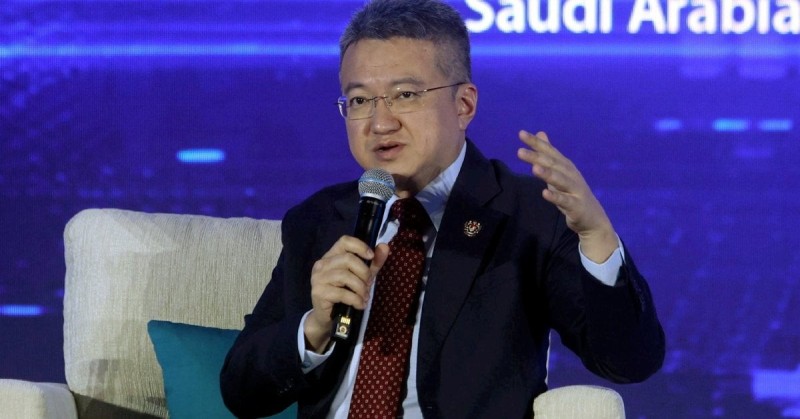

KUALA LUMPUR: Malaysia's semiconductor industry is poised to revolutionise agriculture and address global food security challenges by integrating advanced technology into farming practices.
Speaking at the Asean-GCC economic forum 2025, Deputy Investment, Trade and Industry Minister Liew Chin Tong underscored the sector's importance not only as a hub for multinational investment but also as a driver of innovation across multiple industries.
"The world we live in today is vastly different from just five years ago. We are no longer navigating a single global supply chain but multiple regional supply chains, heavily influenced by geopolitics.
"This shift demands that we rethink our strategies and maximise the potential of our key industries, particularly semiconductors," Liew said.
He shared that Malaysia's semiconductor ecosystem, centred in Penang but extending nationwide, has become a global benchmark.
Traditionally aligned with multinational corporations producing for markets like the United States, the industry is now pivoting toward broader applications and markets, reflecting Malaysia's evolving economic strategy.
Liew said the industry's reputation has drawn significant interest from international partners, with Brazil and India among the most recent collaborators.
"Brazil views our semiconductor capabilities as a model they can learn from, while India, which is aggressively attracting investment in its own semiconductor industry, wants to leverage Malaysia's established ecosystem," Liew said.
Malaysia's ecosystem has become a focal point for foreign investments, supported by a network of local and multinational players.
Liew said Malaysia's semiconductor industry must move beyond its traditional role as a supplier for multinational corporations.
"We have a strength that many other countries do not have. It's time to use this capability to power industries like agriculture, automotive, defence, and more," he said.
Liew also stated that one critical application is addressing global food security.
"Semiconductors can drive agricultural technologies that not only benefit Malaysia but also support countries like Saudi Arabia, Bangladesh, and even parts of Africa.
"By thinking along these lines, Malaysia can position itself as a technology powerhouse," he added.
The broader vision for Malaysia is to evolve from being viewed solely as a trading nation to being recognised as a leader in technology and innovation.
"Policymakers and businesses must align to this goal. Malaysia has the infrastructure, expertise, and global interest to achieve this transformation," Liew said.
He added that the inclusion of China in the Asean-GCC meeting, thanks to the Prime Minister's innovative approach, highlights the opportunities for trilateral collaborations.
By integrating technology and markets from Asia, the GCC and China, Malaysia can further solidify its position on the global stage.
Source: https://www.nst.com.my/business/economy/2025/05/1222776/malaysian-semiconductor-sector-set-integrate-advanced-tech-farming