
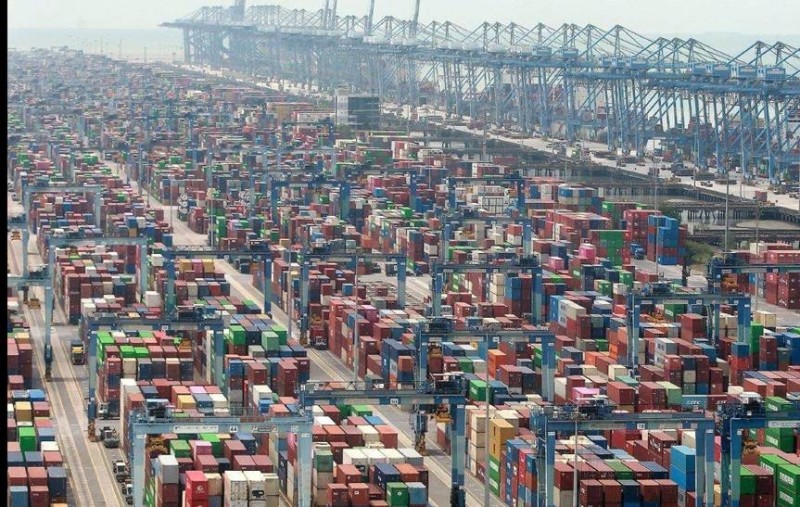

KUALA LUMPUR: Malaysia's trade sector showed resilience through most of 2025, delivering moderate and sustained growth amid a gradual recovery in global demand and firmer external conditions.
The year began on a positive note, with January marking the 13th consecutive month of year-on-year (YoY) growth. Total trade rose 3.1 per cent to RM241.95 billion compared with the same month in 2024.
February maintained the momentum, expanding 5.9 per cent to RM223.89 billion, while the trade surplus rebounded to RM12.62 billion, continuing a streak of surpluses that began in May 2020.
March saw trade reach RM249.89 billion, the highest ever for the month, driven by a 6.8 per cent jump in exports to RM137.31 billion. Imports meanwhile fell 2.8 per cent to RM112.59 billion.
April registered even stronger growth, with trade surging 18.2 per cent YoY to RM261.94 billion, the highest monthly value since August 2022, supported by robust increases in both exports and imports.
Meanwhile, May continued the upward trajectory, with trade hitting RM252.48 billion, another monthly record.
The pace slowed slightly in June, with trade dipping 1.2 per cent to RM234.85 billion, though the first half of the year still recorded a cumulative RM1.465 trillion, the highest ever for first half trade.
July saw a rebound to RM265.92 billion, with exports climbing 6.8 per cent to RM140.45 billion, reflecting sustained global demand for Malaysian goods.
August recorded a minor contraction of 1.9 per cent to RM247.07 billion, amid shifting global trade conditions. Exports, however, continued to grow, while imports fell 5.9 per cent while imports declined by 5.9 per cent to RM115.47 billion.
By September, trade recovered strongly to RM257.51 billion, led by electrical and electronics (E&E) products, machinery, and optical equipment.
October brought record-high trade of RM277.65 billion, with the manufacturing sector, particularly E&E and optical and scientific equipment, driving growth.
November continued the momentum, recording double-digit growth of 11.1 per cent to RM263.83 billion. On a year-to-date basis, Malaysia's trade has reached RM2.77 trillion.
KEY DRIVERS
Universiti Teknologi Mara Business Management Faculty senior lecturer Dr Mohamad Idham Md Razak said Malaysia's trade performance was largely supported by a rebound in the electrical and electronics (E&E) sector.
He said this includes firm demand for commodities such as petroleum products and palm oil, and strengthened trade with key Asian partners also contributed to the performance.
"In addition, selected services-related exports and downstream manufacturing supported overall momentum.
"Going into 2026, these drivers remain broadly sustainable, although they are vulnerable to global growth risks, technology cycle volatility and commodity price fluctuations," he told Business Times.
Idham said for 2025, Malaysia did see a gradual shift in export composition towards higher value-added segments, particularly within advanced E&E components, chemicals and specialised manufacturing inputs.
"While the transition is still incremental rather than transformational, it reflects ongoing efforts to move up the value chain.
"Exports linked to energy transition and renewable-related supply chains also gained some traction, though they remain a relatively small share of total exports at this stage," he added.
2026 OUTLOOK
Idham said Malaysia's trade outlook for 2026 remains cautiously optimistic but is expected to be more measured, supported by ongoing regional integration, a gradual rebound in global technology demand and broader diversification of export markets.
"However, external risks such as slower global growth, geopolitical tensions and uncertain monetary conditions could temper expansion.
"Overall, trade is likely to remain a steady contributor to economic growth rather than a strong acceleration driver," he added.
Meanwhile, Kenanga Research expects Malaysia's external trade sector to expand at a more moderate pace in 2026, with export growth projected to ease to 5.1 per cent from an estimated 6.0 per cent in 2025, compared with 5.8 per cent in 2024.
It added that external headwinds are likely to intensify next year as the impact of US tariffs begins to take hold and China's economic recovery remains sluggish, weighing particularly on commodity-related exports.
"Front-loading to the US in 2025 may unwind in 2026 as orders normalise. Still, shipments to regional partners should continue to grow gradually," it said.
Kenanga Research said a gradual recovery in the global technology cycle, underpinned by sustained demand from artificial intelligence, 5G and electric vehicle segments, is expected to lend support to electronics exports.
However, it maintained a cautiously optimistic stance on the export outlook, noting that performance remains vulnerable to tariff-related risks, subdued global trade momentum and China's uneven recovery.
Source: https://www.nst.com.my/business/economy/2025/12/1347470/2025-year-steady-trade-gains-amid-uncertainty